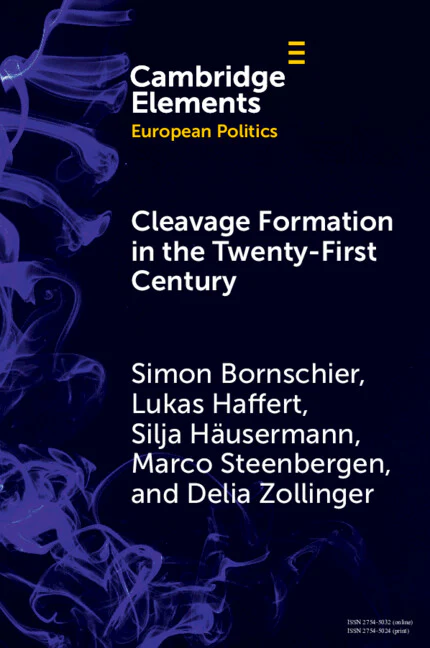
Cleavage Formation in the 21st Century
Western Europe is experiencing growing levels of political polarization between parties of the New Left and the Far Right. The authors argue that this antagonism reflects the emergence of a social cleavage between universalism and particularism. To understand cleavage formation in the midst of party system fragmentation and the proliferation of new competitors, they emphasize the crucial role of group identities. Anchored in social structure, group identities help us understand why specific party appeals resonate with certain groups, thereby mediating the link between socio-structural change and broader party blocks defined by their distinctive ideologies along the new cleavage. Based on original survey data from France, Germany, Switzerland, and the UK, this Element presents evidence for the formation of a universalism–particularism cleavage across European party systems that diverge strongly on institutional and political characteristics. This title is also available as Open Access on Cambridge Core.
Product Information
Product Information
Shipping & Returns
Shipping & Returns
Cleavage Formation in the 21st Century
Cleavage Formation in the 21st Century
Western Europe is experiencing growing levels of political polarization between parties of the New Left and the Far Right. The authors argue that this antagonism reflects the emergence of a social cleavage between universalism and particularism. To understand cleavage formation in the midst of party system fragmentation and the proliferation of new competitors, they emphasize the crucial role of group identities. Anchored in social structure, group identities help us understand why specific party appeals resonate with certain groups, thereby mediating the link between socio-structural change and broader party blocks defined by their distinctive ideologies along the new cleavage. Based on original survey data from France, Germany, Switzerland, and the UK, this Element presents evidence for the formation of a universalism–particularism cleavage across European party systems that diverge strongly on institutional and political characteristics. This title is also available as Open Access on Cambridge Core.
Original: $24.28
-65%$24.28
$8.50Product Information
Product Information
Shipping & Returns
Shipping & Returns
Description
Western Europe is experiencing growing levels of political polarization between parties of the New Left and the Far Right. The authors argue that this antagonism reflects the emergence of a social cleavage between universalism and particularism. To understand cleavage formation in the midst of party system fragmentation and the proliferation of new competitors, they emphasize the crucial role of group identities. Anchored in social structure, group identities help us understand why specific party appeals resonate with certain groups, thereby mediating the link between socio-structural change and broader party blocks defined by their distinctive ideologies along the new cleavage. Based on original survey data from France, Germany, Switzerland, and the UK, this Element presents evidence for the formation of a universalism–particularism cleavage across European party systems that diverge strongly on institutional and political characteristics. This title is also available as Open Access on Cambridge Core.