Empirical Knowledge in the Eighteenth-Century Novel
This Element examines the eighteenth-century novel's contributions to empirical knowledge. Realism has been the conventional framework for treating this subject within literary studies. This Element identifies the limitations of the realism framework for addressing the question of knowledge in the eighteenth-century novel. Moving beyond the familiar focus in the study of novelistic realism on problems of perception and representation, this Element focuses instead on how the eighteenth-century novel staged problems of inductive reasoning. It argues that we should understand the novel's contributions to empirical knowledge primarily in terms of what the novel offered as training ground for methods of reasoning, rather than what it offered in terms of formal innovations for representing knowledge. We learn from such a shift that the eighteenth-century novel was not a failed experiment in realism, or in representing things as they are, but a valuable system for reasoning and thought experiment.
Product Information
Product Information
Shipping & Returns
Shipping & Returns
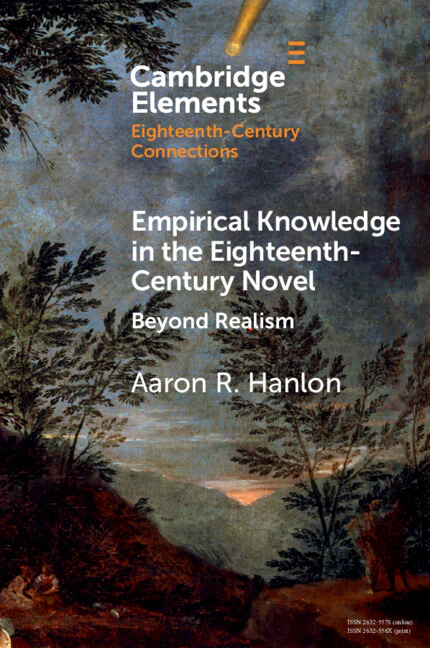
Empirical Knowledge in the Eighteenth-Century Novel
Empirical Knowledge in the Eighteenth-Century Novel
This Element examines the eighteenth-century novel's contributions to empirical knowledge. Realism has been the conventional framework for treating this subject within literary studies. This Element identifies the limitations of the realism framework for addressing the question of knowledge in the eighteenth-century novel. Moving beyond the familiar focus in the study of novelistic realism on problems of perception and representation, this Element focuses instead on how the eighteenth-century novel staged problems of inductive reasoning. It argues that we should understand the novel's contributions to empirical knowledge primarily in terms of what the novel offered as training ground for methods of reasoning, rather than what it offered in terms of formal innovations for representing knowledge. We learn from such a shift that the eighteenth-century novel was not a failed experiment in realism, or in representing things as they are, but a valuable system for reasoning and thought experiment.
Original: $24.28
-65%$24.28
$8.50Product Information
Product Information
Shipping & Returns
Shipping & Returns
Description
This Element examines the eighteenth-century novel's contributions to empirical knowledge. Realism has been the conventional framework for treating this subject within literary studies. This Element identifies the limitations of the realism framework for addressing the question of knowledge in the eighteenth-century novel. Moving beyond the familiar focus in the study of novelistic realism on problems of perception and representation, this Element focuses instead on how the eighteenth-century novel staged problems of inductive reasoning. It argues that we should understand the novel's contributions to empirical knowledge primarily in terms of what the novel offered as training ground for methods of reasoning, rather than what it offered in terms of formal innovations for representing knowledge. We learn from such a shift that the eighteenth-century novel was not a failed experiment in realism, or in representing things as they are, but a valuable system for reasoning and thought experiment.