Gauge Theory and the Geometrization of Physics
This Element is broadly about the geometrization of physics, but mostly it is about gauge theories. Gauge theories lie at the heart of modern physics: in particular, they constitute the Standard Model of particle physics. At its simplest, the idea of gauge is that nature is best described using a descriptively redundant language; the different descriptions are said to be related by a gauge symmetry. The over-arching question this Element aims to answer is: why is descriptive redundancy fruitful for physics? I will provide three inter-related answers to the question: ``Why gauge theory?'', that is: why introduce redundancies in our models of nature in the first place? The first is pragmatic, or methodological; the second is based on geometrical considerations, and the third is broadly relational.
Product Information
Product Information
Shipping & Returns
Shipping & Returns
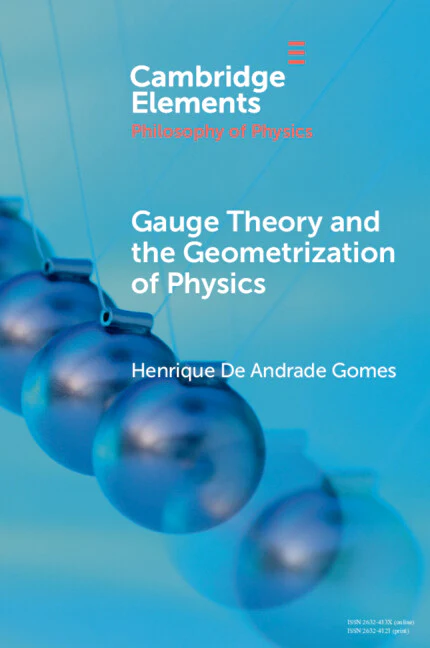
Gauge Theory and the Geometrization of Physics
Gauge Theory and the Geometrization of Physics
This Element is broadly about the geometrization of physics, but mostly it is about gauge theories. Gauge theories lie at the heart of modern physics: in particular, they constitute the Standard Model of particle physics. At its simplest, the idea of gauge is that nature is best described using a descriptively redundant language; the different descriptions are said to be related by a gauge symmetry. The over-arching question this Element aims to answer is: why is descriptive redundancy fruitful for physics? I will provide three inter-related answers to the question: ``Why gauge theory?'', that is: why introduce redundancies in our models of nature in the first place? The first is pragmatic, or methodological; the second is based on geometrical considerations, and the third is broadly relational.
Original: $24.28
-65%$24.28
$8.50Product Information
Product Information
Shipping & Returns
Shipping & Returns
Description
This Element is broadly about the geometrization of physics, but mostly it is about gauge theories. Gauge theories lie at the heart of modern physics: in particular, they constitute the Standard Model of particle physics. At its simplest, the idea of gauge is that nature is best described using a descriptively redundant language; the different descriptions are said to be related by a gauge symmetry. The over-arching question this Element aims to answer is: why is descriptive redundancy fruitful for physics? I will provide three inter-related answers to the question: ``Why gauge theory?'', that is: why introduce redundancies in our models of nature in the first place? The first is pragmatic, or methodological; the second is based on geometrical considerations, and the third is broadly relational.