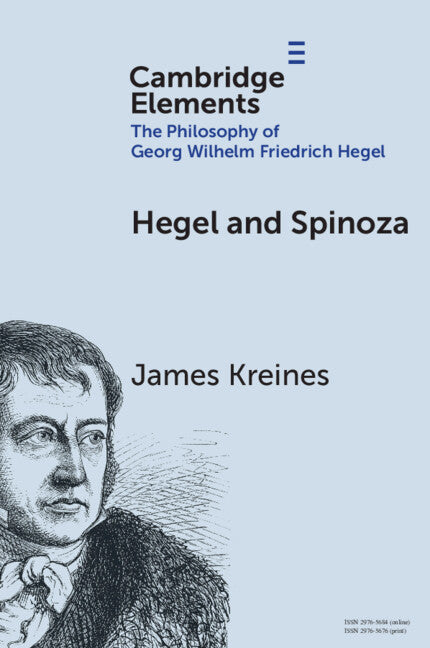
Hegel and Spinoza
This Element concerns Hegel's engagement with Spinoza's metaphysics, and divides into three main parts. The first enlists help from Hegel's interpretation to introduce and defend philosophical strengths in Spinoza's defense of metaphysical monism. The second defends Hegel's criticism of Spinoza, concluding that Spinoza's philosophy must eliminate all finitude and determinacy, leaving only a shapeless abyss. The third employs these defenses to open up an approach to the philosophical interpretation of Hegel's Logic, the core of his philosophical system, understanding the meaning of Hegel's ambitious claims in terms of reasons that make them more than the mere unpacking of assumptions.
Product Information
Product Information
Shipping & Returns
Shipping & Returns
Hegel and Spinoza
Hegel and Spinoza
This Element concerns Hegel's engagement with Spinoza's metaphysics, and divides into three main parts. The first enlists help from Hegel's interpretation to introduce and defend philosophical strengths in Spinoza's defense of metaphysical monism. The second defends Hegel's criticism of Spinoza, concluding that Spinoza's philosophy must eliminate all finitude and determinacy, leaving only a shapeless abyss. The third employs these defenses to open up an approach to the philosophical interpretation of Hegel's Logic, the core of his philosophical system, understanding the meaning of Hegel's ambitious claims in terms of reasons that make them more than the mere unpacking of assumptions.
Product Information
Product Information
Shipping & Returns
Shipping & Returns
Description
This Element concerns Hegel's engagement with Spinoza's metaphysics, and divides into three main parts. The first enlists help from Hegel's interpretation to introduce and defend philosophical strengths in Spinoza's defense of metaphysical monism. The second defends Hegel's criticism of Spinoza, concluding that Spinoza's philosophy must eliminate all finitude and determinacy, leaving only a shapeless abyss. The third employs these defenses to open up an approach to the philosophical interpretation of Hegel's Logic, the core of his philosophical system, understanding the meaning of Hegel's ambitious claims in terms of reasons that make them more than the mere unpacking of assumptions.