Herbert Eimert and the Darmstadt School
After 1951, the discourse surrounding both the Darmstadt courses in particular and European New Music more broadly shifted away from a dodecaphonic vocabulary in favour of concepts such as 'punctual music', 'post-Webern music', and 'static music', all collected under the newly-christened unity of the Darmstadt School. This study proposes a genealogy of the Darmstadt School through the institutional influence and writings of Herbert Eimert. It demonstrates that Eimert's understanding of music history - whereby technical procedures are universalised as the acme of historical progress - was adopted as the institutional discourse of New Music in Europe, and remains central to both textbook and critical scholarly accounts which attempt to make sense of the avant-garde after World War II.
Product Information
Product Information
Shipping & Returns
Shipping & Returns
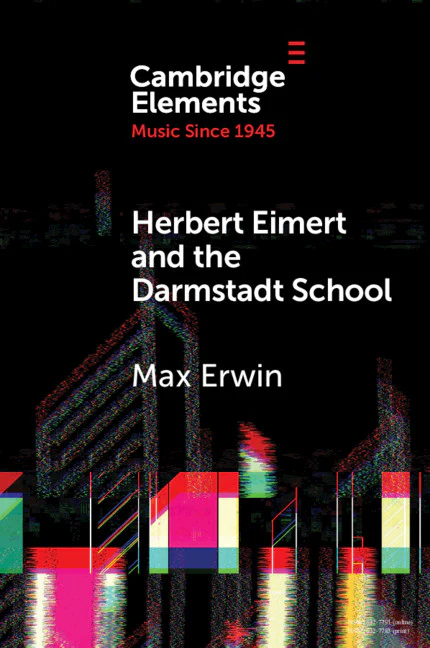
Herbert Eimert and the Darmstadt School
Herbert Eimert and the Darmstadt School
After 1951, the discourse surrounding both the Darmstadt courses in particular and European New Music more broadly shifted away from a dodecaphonic vocabulary in favour of concepts such as 'punctual music', 'post-Webern music', and 'static music', all collected under the newly-christened unity of the Darmstadt School. This study proposes a genealogy of the Darmstadt School through the institutional influence and writings of Herbert Eimert. It demonstrates that Eimert's understanding of music history - whereby technical procedures are universalised as the acme of historical progress - was adopted as the institutional discourse of New Music in Europe, and remains central to both textbook and critical scholarly accounts which attempt to make sense of the avant-garde after World War II.
Original: $24.28
-65%$24.28
$8.50Product Information
Product Information
Shipping & Returns
Shipping & Returns
Description
After 1951, the discourse surrounding both the Darmstadt courses in particular and European New Music more broadly shifted away from a dodecaphonic vocabulary in favour of concepts such as 'punctual music', 'post-Webern music', and 'static music', all collected under the newly-christened unity of the Darmstadt School. This study proposes a genealogy of the Darmstadt School through the institutional influence and writings of Herbert Eimert. It demonstrates that Eimert's understanding of music history - whereby technical procedures are universalised as the acme of historical progress - was adopted as the institutional discourse of New Music in Europe, and remains central to both textbook and critical scholarly accounts which attempt to make sense of the avant-garde after World War II.