Making Sense of Knowledge
What counts as knowledge, expertise, and theory? How are knowledge hierarchies connected to emotional and hierarchies of subjects? How does the division between emotion and reason shape our experiences? The Element addresses these questions by exploring the Greek feminist birth control movement (1974–1986), focusing on the production and circulation of knowledge, termed as affective epistemologies of antimilima (talking back). This concept reinterprets women's lived and embodied knowledge, emerging at the intersection of academia and social movements, as a form of resistance against established expertise. By drawing on feminist theorists like Donna Haraway and Sara Ahmed, the Element critically examines the relationship between scientific and experiential knowledge. This analysis reconfigures the interplay between rationality and emotion, providing a critique to the binary model of thought and suggesting new avenues for democratic knowledge, society, and citizenship. Historical tracing of these theories offers a counter-narrative to contemporary anti-gender, anti-intellectual, and far-right politics.
Product Information
Product Information
Shipping & Returns
Shipping & Returns
Making Sense of Knowledge
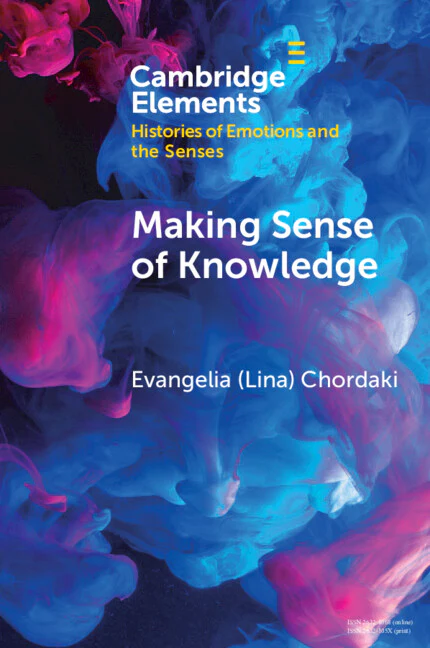
Making Sense of Knowledge
What counts as knowledge, expertise, and theory? How are knowledge hierarchies connected to emotional and hierarchies of subjects? How does the division between emotion and reason shape our experiences? The Element addresses these questions by exploring the Greek feminist birth control movement (1974–1986), focusing on the production and circulation of knowledge, termed as affective epistemologies of antimilima (talking back). This concept reinterprets women's lived and embodied knowledge, emerging at the intersection of academia and social movements, as a form of resistance against established expertise. By drawing on feminist theorists like Donna Haraway and Sara Ahmed, the Element critically examines the relationship between scientific and experiential knowledge. This analysis reconfigures the interplay between rationality and emotion, providing a critique to the binary model of thought and suggesting new avenues for democratic knowledge, society, and citizenship. Historical tracing of these theories offers a counter-narrative to contemporary anti-gender, anti-intellectual, and far-right politics.
Original: $24.28
-65%$24.28
$8.50Product Information
Product Information
Shipping & Returns
Shipping & Returns
Description
What counts as knowledge, expertise, and theory? How are knowledge hierarchies connected to emotional and hierarchies of subjects? How does the division between emotion and reason shape our experiences? The Element addresses these questions by exploring the Greek feminist birth control movement (1974–1986), focusing on the production and circulation of knowledge, termed as affective epistemologies of antimilima (talking back). This concept reinterprets women's lived and embodied knowledge, emerging at the intersection of academia and social movements, as a form of resistance against established expertise. By drawing on feminist theorists like Donna Haraway and Sara Ahmed, the Element critically examines the relationship between scientific and experiential knowledge. This analysis reconfigures the interplay between rationality and emotion, providing a critique to the binary model of thought and suggesting new avenues for democratic knowledge, society, and citizenship. Historical tracing of these theories offers a counter-narrative to contemporary anti-gender, anti-intellectual, and far-right politics.