Mind and Psychology in Early China
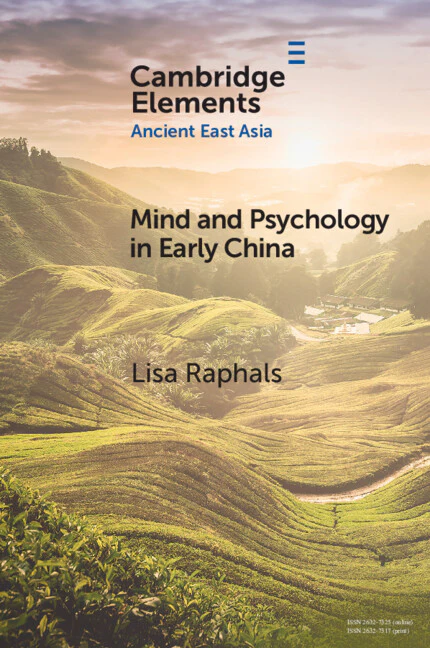
This Element describes early Chinese views of the heart-mind (xin 心) and its relation to the psychology of a whole person, including the body, affective and cognitive faculties, and the spirit (shén 神). It argues for a divergence in Warring States thought between 'mind-centered' and 'spirit-centered' approaches to self-cultivation. It surveys the Analects, Mengzi, Guanzi, Zhuangzi, Xunzi, Huainanzi, the Huangdi neijing, and excavated medical manuscripts from Mawangdui, as well as a brief comparative perspective to ancient Greek views of these topics. It argues for a contrast between post-Cartesian dualism and Chinese and Greek psycho-physicalism.
Product Information
Product Information
Shipping & Returns
Shipping & Returns
Mind and Psychology in Early China
Mind and Psychology in Early China
This Element describes early Chinese views of the heart-mind (xin 心) and its relation to the psychology of a whole person, including the body, affective and cognitive faculties, and the spirit (shén 神). It argues for a divergence in Warring States thought between 'mind-centered' and 'spirit-centered' approaches to self-cultivation. It surveys the Analects, Mengzi, Guanzi, Zhuangzi, Xunzi, Huainanzi, the Huangdi neijing, and excavated medical manuscripts from Mawangdui, as well as a brief comparative perspective to ancient Greek views of these topics. It argues for a contrast between post-Cartesian dualism and Chinese and Greek psycho-physicalism.
Original: $24.28
-65%$24.28
$8.50Product Information
Product Information
Shipping & Returns
Shipping & Returns
Description
This Element describes early Chinese views of the heart-mind (xin 心) and its relation to the psychology of a whole person, including the body, affective and cognitive faculties, and the spirit (shén 神). It argues for a divergence in Warring States thought between 'mind-centered' and 'spirit-centered' approaches to self-cultivation. It surveys the Analects, Mengzi, Guanzi, Zhuangzi, Xunzi, Huainanzi, the Huangdi neijing, and excavated medical manuscripts from Mawangdui, as well as a brief comparative perspective to ancient Greek views of these topics. It argues for a contrast between post-Cartesian dualism and Chinese and Greek psycho-physicalism.