Nonbinary
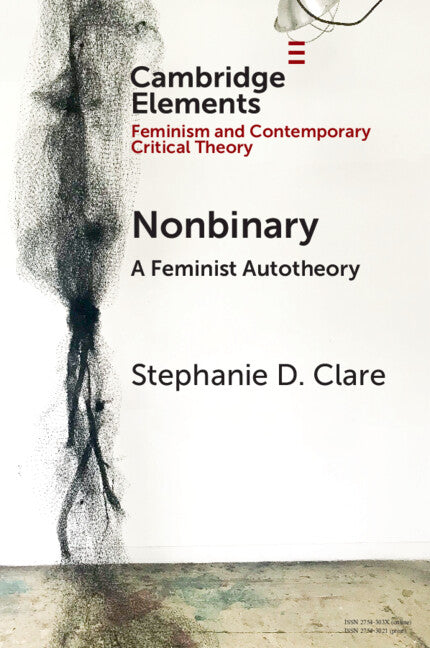
This autotheoretical Element, written in the tense space between feminist and trans theory, argues that movement between 'woman' and 'nonbinary' is possible, affectively and politically. In fact, a nonbinary structure of feeling has been central in the history of feminist thought, such as in Simone de Beauvoir's The Second Sex (1949). This structure of feeling is not antifeminist but indexical of a desire for a form of embodiment and relationality beyond binary sex and gender. Finally, the Element provides a partial defense of nonbinary gender identity by tracing the development of the term in online spaces of the early 2000s. While it might be tempting to read its development as symptomatic of the forms of selfhood reproduced in (neo)liberal, racialized platform capitalism, this reading is too simplistic because it misses how the term emerged within communities of care.
Product Information
Product Information
Shipping & Returns
Shipping & Returns
Nonbinary
Nonbinary
This autotheoretical Element, written in the tense space between feminist and trans theory, argues that movement between 'woman' and 'nonbinary' is possible, affectively and politically. In fact, a nonbinary structure of feeling has been central in the history of feminist thought, such as in Simone de Beauvoir's The Second Sex (1949). This structure of feeling is not antifeminist but indexical of a desire for a form of embodiment and relationality beyond binary sex and gender. Finally, the Element provides a partial defense of nonbinary gender identity by tracing the development of the term in online spaces of the early 2000s. While it might be tempting to read its development as symptomatic of the forms of selfhood reproduced in (neo)liberal, racialized platform capitalism, this reading is too simplistic because it misses how the term emerged within communities of care.
Original: $24.28
-65%$24.28
$8.50Product Information
Product Information
Shipping & Returns
Shipping & Returns
Description
This autotheoretical Element, written in the tense space between feminist and trans theory, argues that movement between 'woman' and 'nonbinary' is possible, affectively and politically. In fact, a nonbinary structure of feeling has been central in the history of feminist thought, such as in Simone de Beauvoir's The Second Sex (1949). This structure of feeling is not antifeminist but indexical of a desire for a form of embodiment and relationality beyond binary sex and gender. Finally, the Element provides a partial defense of nonbinary gender identity by tracing the development of the term in online spaces of the early 2000s. While it might be tempting to read its development as symptomatic of the forms of selfhood reproduced in (neo)liberal, racialized platform capitalism, this reading is too simplistic because it misses how the term emerged within communities of care.