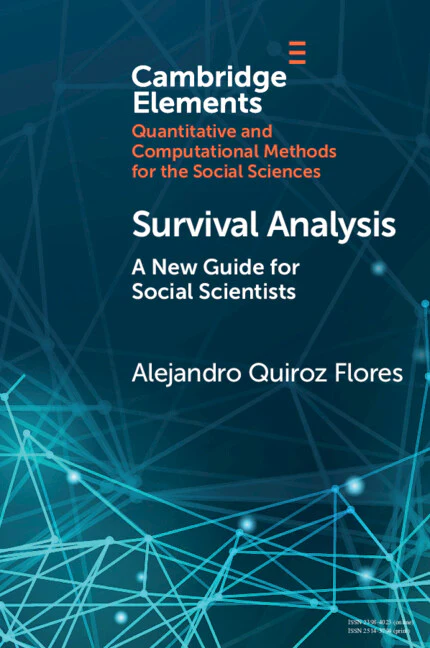
Survival Analysis
Quantitative social scientists use survival analysis to understand the forces that determine the duration of events. This Element provides a guideline to new techniques and models in survival analysis, particularly in three areas: non-proportional covariate effects, competing risks, and multi-state models. It also revisits models for repeated events. The Element promotes multi-state models as a unified framework for survival analysis and highlights the role of general transition probabilities as key quantities of interest that complement traditional hazard analysis. These quantities focus on the long term probabilities that units will occupy particular states conditional on their current state, and they are central in the design and implementation of policy interventions.
Product Information
Product Information
Shipping & Returns
Shipping & Returns
Survival Analysis
Survival Analysis
Quantitative social scientists use survival analysis to understand the forces that determine the duration of events. This Element provides a guideline to new techniques and models in survival analysis, particularly in three areas: non-proportional covariate effects, competing risks, and multi-state models. It also revisits models for repeated events. The Element promotes multi-state models as a unified framework for survival analysis and highlights the role of general transition probabilities as key quantities of interest that complement traditional hazard analysis. These quantities focus on the long term probabilities that units will occupy particular states conditional on their current state, and they are central in the design and implementation of policy interventions.
Product Information
Product Information
Shipping & Returns
Shipping & Returns
Description
Quantitative social scientists use survival analysis to understand the forces that determine the duration of events. This Element provides a guideline to new techniques and models in survival analysis, particularly in three areas: non-proportional covariate effects, competing risks, and multi-state models. It also revisits models for repeated events. The Element promotes multi-state models as a unified framework for survival analysis and highlights the role of general transition probabilities as key quantities of interest that complement traditional hazard analysis. These quantities focus on the long term probabilities that units will occupy particular states conditional on their current state, and they are central in the design and implementation of policy interventions.