The Hidden Talents Framework
Although early-life adversity can undermine healthy development, an evolutionary-developmental perspective implies that children growing up in harsh environments will develop intact, or even enhanced, skills for solving problems in high‐adversity contexts (i.e., 'hidden talents'). This Element situates the hidden talents model within a larger interdisciplinary framework. Summarizing theory and research on hidden talents, it proposes that stress-adapted skills represent a form of adaptive intelligence enabling individuals to function within the constraints of harsh environments. It discusses potential applications of this perspective to multiple sectors concerned with youth from harsh environments, including education, social services, and juvenile justice, and compares the hidden talents model with contemporary developmental resilience models. The hidden talents approach, it concludes, offers exciting directions for research on childhood adversity, with translational implications for leveraging stress-adapted skills to more effectively tailor education, jobs, and interventions to fit the needs of individuals from a diverse range of life circumstances.
Product Information
Product Information
Shipping & Returns
Shipping & Returns
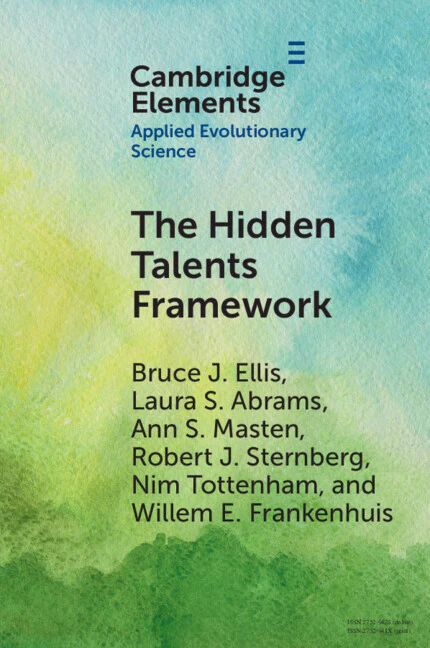
The Hidden Talents Framework
The Hidden Talents Framework
Although early-life adversity can undermine healthy development, an evolutionary-developmental perspective implies that children growing up in harsh environments will develop intact, or even enhanced, skills for solving problems in high‐adversity contexts (i.e., 'hidden talents'). This Element situates the hidden talents model within a larger interdisciplinary framework. Summarizing theory and research on hidden talents, it proposes that stress-adapted skills represent a form of adaptive intelligence enabling individuals to function within the constraints of harsh environments. It discusses potential applications of this perspective to multiple sectors concerned with youth from harsh environments, including education, social services, and juvenile justice, and compares the hidden talents model with contemporary developmental resilience models. The hidden talents approach, it concludes, offers exciting directions for research on childhood adversity, with translational implications for leveraging stress-adapted skills to more effectively tailor education, jobs, and interventions to fit the needs of individuals from a diverse range of life circumstances.
Original: $24.28
-65%$24.28
$8.50Product Information
Product Information
Shipping & Returns
Shipping & Returns
Description
Although early-life adversity can undermine healthy development, an evolutionary-developmental perspective implies that children growing up in harsh environments will develop intact, or even enhanced, skills for solving problems in high‐adversity contexts (i.e., 'hidden talents'). This Element situates the hidden talents model within a larger interdisciplinary framework. Summarizing theory and research on hidden talents, it proposes that stress-adapted skills represent a form of adaptive intelligence enabling individuals to function within the constraints of harsh environments. It discusses potential applications of this perspective to multiple sectors concerned with youth from harsh environments, including education, social services, and juvenile justice, and compares the hidden talents model with contemporary developmental resilience models. The hidden talents approach, it concludes, offers exciting directions for research on childhood adversity, with translational implications for leveraging stress-adapted skills to more effectively tailor education, jobs, and interventions to fit the needs of individuals from a diverse range of life circumstances.