Virtual Paleontology
Imaging and visualizing fossils in three dimensions with tomography is a powerful approach in paleontology. Here, the authors introduce select destructive and non-destructive tomographic techniques that are routinely applied to fossils and review how this work has improved our understanding of the anatomy, function, taphonomy, and phylogeny of fossil echinoderms. Building on this, this Element discusses how new imaging and computational methods have great promise for addressing long-standing paleobiological questions. Future efforts to improve the accessibility of the data underlying this work will be key for realizing the potential of this virtual world of paleontology.
Product Information
Product Information
Shipping & Returns
Shipping & Returns
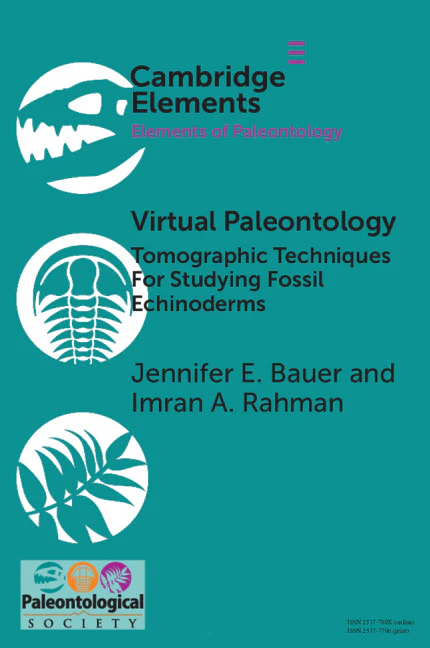
Virtual Paleontology
Virtual Paleontology
Imaging and visualizing fossils in three dimensions with tomography is a powerful approach in paleontology. Here, the authors introduce select destructive and non-destructive tomographic techniques that are routinely applied to fossils and review how this work has improved our understanding of the anatomy, function, taphonomy, and phylogeny of fossil echinoderms. Building on this, this Element discusses how new imaging and computational methods have great promise for addressing long-standing paleobiological questions. Future efforts to improve the accessibility of the data underlying this work will be key for realizing the potential of this virtual world of paleontology.
Original: $24.28
-65%$24.28
$8.50Product Information
Product Information
Shipping & Returns
Shipping & Returns
Description
Imaging and visualizing fossils in three dimensions with tomography is a powerful approach in paleontology. Here, the authors introduce select destructive and non-destructive tomographic techniques that are routinely applied to fossils and review how this work has improved our understanding of the anatomy, function, taphonomy, and phylogeny of fossil echinoderms. Building on this, this Element discusses how new imaging and computational methods have great promise for addressing long-standing paleobiological questions. Future efforts to improve the accessibility of the data underlying this work will be key for realizing the potential of this virtual world of paleontology.