Wittgenstein on Private Language, Sensation and Perception
Wittgenstein's critique of private language in the Philosophical Investigations does not attempt to refute the possibility of a private sensation-language, let alone in any one argument, as has often been thought. Nor does it aim to establish that language is intrinsically social. Instead, PI §§243–315 presents a series of arguments, suggestions, questions, examples and thought-experiments whose purpose is to undermine the temptation to think of sensations and perceptual experiences as private objects occupying a private phenomenal space. These themes are clear developments of Wittgenstein's earlier critique of sense-datum theories (1929–1936) and his insight that naming is more complex than he had assumed in the Tractatus.
Product Information
Product Information
Shipping & Returns
Shipping & Returns
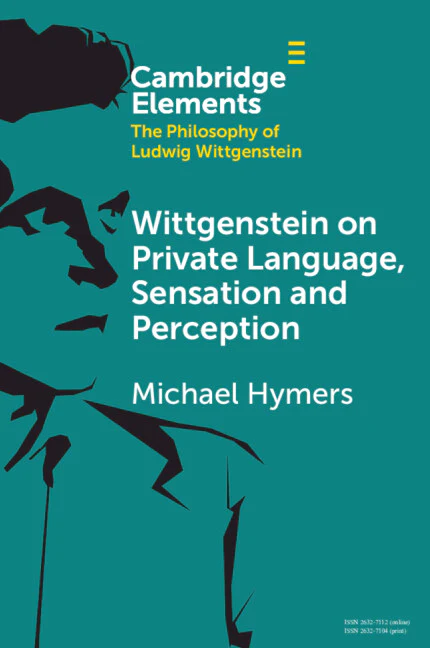
Wittgenstein on Private Language, Sensation and Perception
Wittgenstein on Private Language, Sensation and Perception
Wittgenstein's critique of private language in the Philosophical Investigations does not attempt to refute the possibility of a private sensation-language, let alone in any one argument, as has often been thought. Nor does it aim to establish that language is intrinsically social. Instead, PI §§243–315 presents a series of arguments, suggestions, questions, examples and thought-experiments whose purpose is to undermine the temptation to think of sensations and perceptual experiences as private objects occupying a private phenomenal space. These themes are clear developments of Wittgenstein's earlier critique of sense-datum theories (1929–1936) and his insight that naming is more complex than he had assumed in the Tractatus.
Original: $24.28
-65%$24.28
$8.50Product Information
Product Information
Shipping & Returns
Shipping & Returns
Description
Wittgenstein's critique of private language in the Philosophical Investigations does not attempt to refute the possibility of a private sensation-language, let alone in any one argument, as has often been thought. Nor does it aim to establish that language is intrinsically social. Instead, PI §§243–315 presents a series of arguments, suggestions, questions, examples and thought-experiments whose purpose is to undermine the temptation to think of sensations and perceptual experiences as private objects occupying a private phenomenal space. These themes are clear developments of Wittgenstein's earlier critique of sense-datum theories (1929–1936) and his insight that naming is more complex than he had assumed in the Tractatus.